Light, Fire, Sound and Motion: Designing a Pool for Day and Night
Four elements decide whether a backyard pool is only for swimming or a place people want to stay until late.
October 26, 2026 · 4 min read
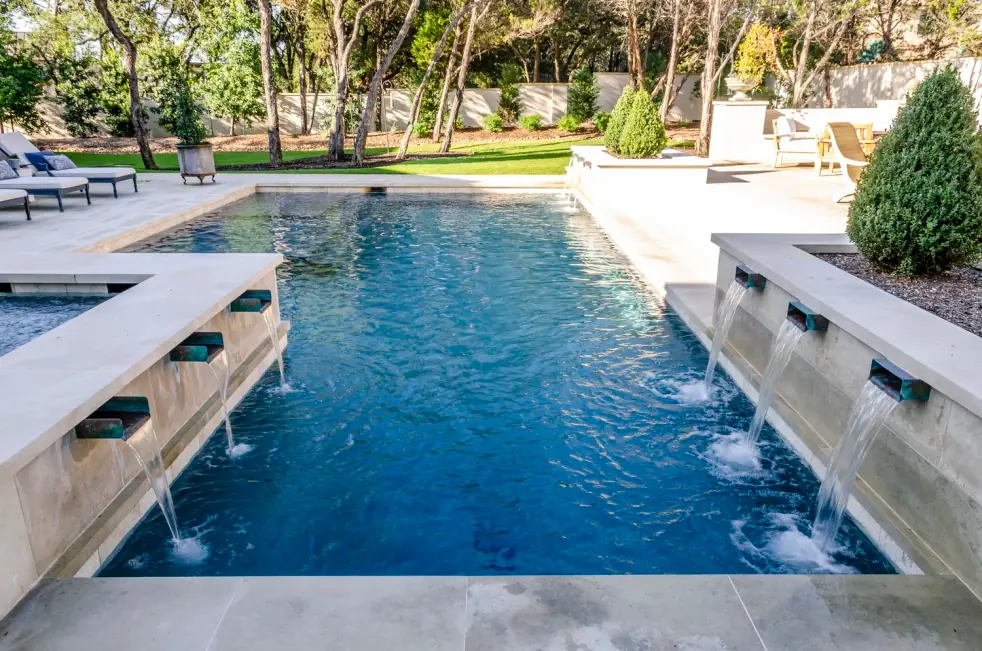
A pool at noon and a pool at nine in the evening are two different places. At noon, the water is a color and a surface. After dark, it becomes a source of light, a mirror, a sound, and sometimes a warm glow from a fire bowl a few steps away. The best backyards are designed for both. Aqua Builders founder Ebbn Milks describes his approach this way: "Form and function must work hand in hand while incorporating the elements of a complete design: light, fire, sound and motion." Here's how each of the four works in practice.
Light
Lighting is the element most people think about last and regret most when it's an afterthought. Good pool lighting works on three levels. Underwater fixtures make the water itself glow and show the shape of the shell. Landscape lighting, such as uplights on trees, washes on stone walls and low path lights, frames the space around the water. And lighting at the edges of the structure, on steps, benches and walkways, keeps people oriented once the sun goes down.
Live oaks and limestone take light beautifully, so plan fixture positions during design. Conduit has to be in the ground before the concrete and hardscape are finished. Aqua Builders handles exterior lighting design and installation as part of the same scope as the pool, so the circuits, controls and fixtures are planned together instead of fitted around each other.
Surfaces matter as much as fixtures. A dark interior finish makes water read deeper and turns the surface into a mirror for sky, trees and the house. A lighter finish glows brighter at night with the same lamps.
Fire
Fire is the element that makes a water environment feel like a place to stay rather than a place to swim. Fire bowls on a raised wall, a linear burner set into a spillover edge, a fire pit on the terrace beyond the coping: each brings warmth, flicker and a focal point after dark.
Fire features need a fuel supply, shutoffs and controls, and they need to be placed with seating, wind and clearances in mind. Those are design-stage decisions. Aqua Builders lists fire features alongside water features, interactive water and lighting elements in its construction scope, which is how it should be: one team, one set of drawings, and one place where fuel lines, power and plumbing are routed together.
Sound
Sound is the most overlooked of the four, and the one guests notice without being able to say why. Moving water makes noise, and that noise can be shaped. A thin sheet of water falling a short distance sounds soft. A thicker stream falling farther into a deep basin sounds louder and lower. A copper scupper that throws a clean arc into the pool sounds different again from a rain curtain that drops across a wall.
Used well, sound solves problems. A fountain or waterfall near a seating area can soften road or neighbor noise and give a conversation a little privacy. Used badly, it's a constant splash that wears on the people nearby. That's why sound belongs in the design conversation: the height of a drop, the volume of flow, the surface the water lands on and the distance to the nearest bedroom window are all decisions you can make on paper.
Motion
Motion is what separates a living water feature from a still tank. It can be big, like a vanishing edge spilling toward a lake view, or small, like a bubbler in a shallow sun shelf. It can be playful, like a jumping jet, or contemplative, like a sculptural fountain in a reflecting pool. Aqua Builders' catalog of elements includes fountains, glass walls, a meditation garden with a reflective pool, natural creeks and lazy rivers, and each one gives water a different kind of movement.
Motion and light work together. Moving water scatters light, while a still surface gives clean reflections. Many good designs use both: a calm main body and one or two features that move.
Designing day and night moods together
Day and night moods are a named category in the firm's catalog of elements, which says something: the mood is designed, not accidental. The practical approach is to decide what each part of the day should feel like, then work backward. Morning and midday might call for a bright, open pool with a cool shaded seating area. Evening might call for lit fire bowls, running scuppers and low light on the stone.
In 2023, Luxury Pools + Outdoor Living gave Aqua Builders a Pinnacle Award for a project called "Waterfront Elegance," which combined multiple pools, fire features, a rain curtain and a sculptural fountain. Several elements in one landscape is exactly where planning matters most, because each one has to be served by the same power, plumbing and fuel supply, and all of them have to be controllable from one place.
A short checklist for your first design meeting
- Where will people sit at night, and what will they see from there?
- Which trees and walls should be lit, and where does the conduit run?
- Do you want fire, and where do the fuel line and shutoff go?
- What should the water sound like from the bedroom and from the patio?
- Which features run all day, and which are saved for an evening?
If you want a pool that works at noon and after dark, start the conversation early. Call Aqua Builders at (512) 722-3636 or email sales@aquabuilders.com, and one of the project managers will contact you about beginning the proposal process.
Aqua Builders, (512) 722-3636
Call (512) 722-3636More articles
What a Full CAD Pool Set Contains, and Why You Want One Before Excavation
The rendering sells the idea, but the CAD set is the document a crew, an engineer and an inspector actually build from.
Building Water on a Hill Country Slope: Cliffsides, Grottos and Limestone
On a slope, the grade that complicates excavation also lets water fall, spill and disappear in ways a flat yard can't.