Building Water on a Hill Country Slope: Cliffsides, Grottos and Limestone
On a slope, the grade that complicates excavation also lets water fall, spill and disappear in ways a flat yard can't.
October 26, 2026 · 4 min read
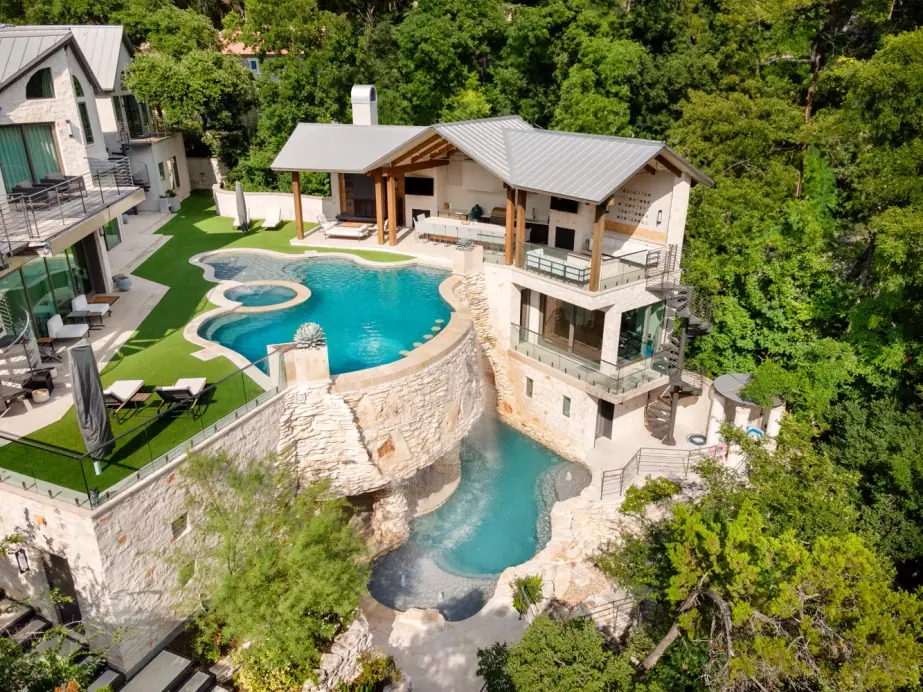
Flat lots are the exception west of Austin. Around Westlake, Lake Austin, Lake Travis and Driftwood, houses sit on ledges, ridges and hillsides, and the best view usually comes with a drop. For a pool designer, a slope is both the problem and the opportunity. The same grade that complicates excavation also lets water fall, spill and disappear in ways a flat yard can't. Aqua Builders lists cliffside builds, lakeside builds, natural caves and natural pools and creeks in its catalog of elements, and its residential portfolio includes a Westlake Cliffside project. Here's what goes into building water on that kind of ground.
Start with the ground
On a slope, the site tells you what the design can be. Before shapes are drawn, someone has to understand how the ground is built: how deep the soil sits over rock, where water runs during a storm, what holds up the terrace above, and what the lower grade needs to stay stable. Central Texas is limestone country, and rock changes how a pool is excavated and how a shell is anchored. Rather than guess, a good builder surveys the site, lays out the work and coordinates with civil and structural engineers early. Aqua Builders' master planning covers site work, civil work and structural engineering alongside the pool itself, which is how a cliffside design stays buildable.
The same thinking applies to water that isn't in the pool. Stormwater has to go somewhere. The firm's scope includes civil systems and rain reclamation, so runoff can be managed or captured instead of sheeting across a new terrace.
Cliffside pools and the long drop
The signature cliffside move is stacking water: an upper pool, often with a vanishing edge, spilling toward a lower pool or pond. When it's done well, the upper water appears to hang over the view, and the drop below becomes a feature rather than a hazard. One Aqua Builders cliffside residence shows the idea from above: an upper pool, a stone-faced drop to a lower grotto pool, and a waterfall connecting the two.
Doing that well involves retaining structures, careful edge detailing and a plan for circulation between levels. Water that falls from an upper level has to be returned to the equipment, and the pumps that lift it have to be sized for the height and the flow. That's one more reason the piping isometric, with its GPM by pump speed, matters on a hillside more than almost anywhere else.
Grottos and natural caves
A grotto is a cave-like space built into or beneath the stone, often behind a waterfall, with seating, a swim-through or a bar. A natural cave carries the idea further, sculpted so the rock looks like it was always there. Both rely on shaped concrete and masonry, and both depend on lighting and sound more than any other kind of pool, because a grotto is an enclosed space. Light placement decides whether it feels magical or cramped. Sound bounces off the walls, so a waterfall that's pleasant in the open can be loud inside.
A few practical points are worth raising early: where people can stand and sit, how the space drains and ventilates, and how a technician reaches the fixtures behind the water. A grotto that can't be serviced is a grotto that eventually looks neglected.
Limestone and masonry
On a Hill Country site, stone does the visual work. Limestone coping, stone-faced walls and cut-stone steps tie the pool to the landscape so it doesn't look dropped in. Aqua Builders lists architectural masonry for buildings and hardscape among its trades, and its team includes a materials sourcing specialist, Scott Gerhardt, who is a certified speaker for the Natural Stone Institute. In practice that means someone is looking at the actual stone, its color range, its finish and its supply, before the order is placed.
A few craft details are worth knowing. Stone laid in a consistent pattern reads as formal and modern, while irregular, thicker pieces read as natural. Limestone varies from cream to tan to gray, and samples should be viewed in your own light, both wet and dry. Mortar joints, drip edges and the way stone meets the waterline affect how a wall looks as it ages as well as on the day it's finished.
Lakeside variations
Lakeside builds raise their own questions: the view to the lake beyond the pool, how the two bodies of water relate, and how the hillside meets the shore. A pool that sits above a lake often works best when its edge lines up with the lake's horizon, so the two read as one. Lake Austin, Lake Travis and the surrounding hills are the backdrop for many of the projects in the firm's portfolio, including Red Oak on Lake Austin and Lakeshore Drive.
Questions to settle before design begins on a slope
- What does the ground hold beneath the terrace, soil or rock, and who has confirmed it?
- Where does stormwater travel during a heavy rain, and where should it go instead?
- How will equipment and materials reach the work area?
- Which stone suits the house and the hillside, and have you seen it wet and dry?
- How will a technician reach every pump, light and valve once the build is finished?
Slopes reward careful planning and punish improvisation. If you own a lot with a view and a grade to match, call Aqua Builders at (512) 722-3636 or email sales@aquabuilders.com to start the proposal process, and bring your questions about the ground.
Aqua Builders, (512) 722-3636
Call (512) 722-3636More articles
What a Full CAD Pool Set Contains, and Why You Want One Before Excavation
The rendering sells the idea, but the CAD set is the document a crew, an engineer and an inspector actually build from.
Light, Fire, Sound and Motion: Designing a Pool for Day and Night
Four elements decide whether a backyard pool is only for swimming or a place people want to stay until late.